The question every decision-maker should ask before adopting healthcare software is not "what does it look like?" but "how do you know it works correctly?". DossiMed answers with measurable proof: our codebase passed the SonarCloud Quality Gate with the status Passed — the industry's strictest continuous software-quality certification level.
This is not a marketing statement. It is the result of an automated analysis of the entire source code, triggered on every change, by one of the reference tools used by engineering teams at the world's largest technology companies.
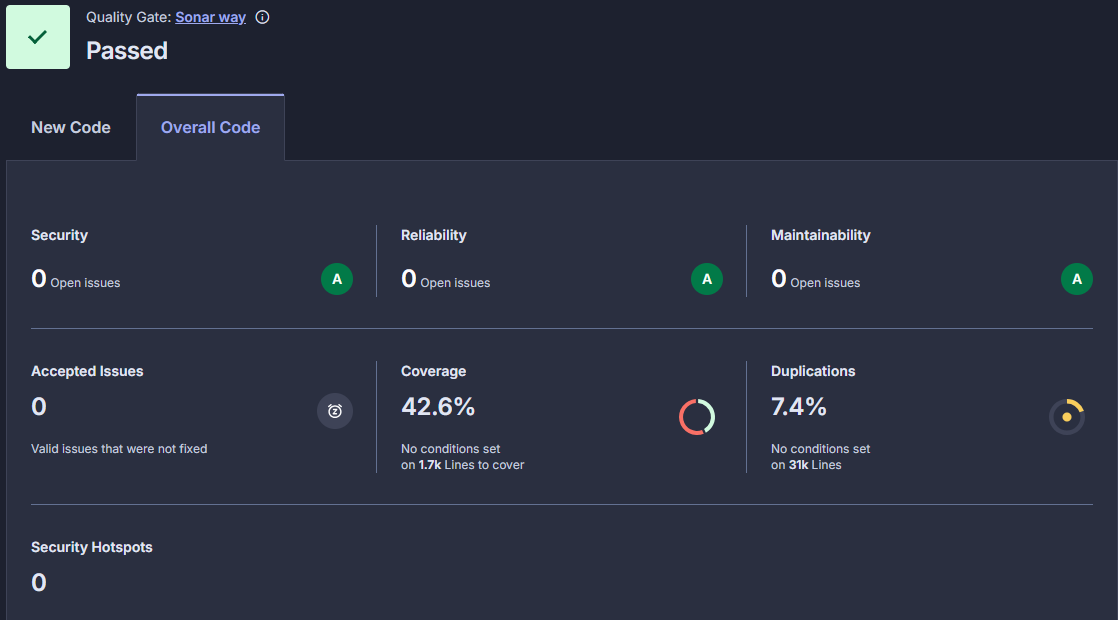
Security — A rating, zero detected vulnerabilities
SonarCloud analyzes every line of code for known vulnerabilities: injections, sensitive-data exposure, authentication misconfigurations, and dozens of other risk categories documented by international security standards (OWASP, CWE).
Result for DossiMed: 0 open security issues across the entire codebase.
For a platform that processes medical data — prescriptions, treatment histories, patient information — code security is not optional. A vulnerability in software is a vulnerability in your patients' privacy. The A rating means no known vulnerabilities have been identified in our code to date.
Reliability — A rating, zero critical bugs
Reliability measures code behavior that can cause crashes, data corruption, or unexpected production results. SonarCloud classifies these issues by severity — from critical bugs that block the system to minor anomalies.
Result for DossiMed: 0 critical or major bugs detected.
Medical-record management software that crashes or displays incorrect data is not just an operational inconvenience — it is a clinical risk. An A rating in reliability means the platform behaves predictably, with no known code path likely to trigger service interruption or data errors.
Maintainability — A rating, an evolvable codebase
Maintainability measures code clarity and consistency: cyclomatic complexity, duplication, and convention violations. Maintainable code is code developers can evolve quickly and safely.
Result for DossiMed: 0 open maintainability issues.
For a healthcare technology partner, maintainability is a promise about the future: every new feature is delivered without degrading what already works. Clean code also reduces the risk that urgent fixes introduce new problems — critical in a regulated environment.
Zero Security Hotspots
Security Hotspots are a category separate from security vulnerabilities. They are code patterns that, depending on context, could represent a risk — and require manual review by a security engineer to validate or dismiss.
What 0 hotspots means
- No sensitive code pattern was flagged for review across the entire codebase
- The team has no pending security-review debt
- Every potentially risky area has already been examined and resolved
The combination of 0 security vulnerabilities and 0 hotspots is the most favorable result a static-analysis tool can produce. This is what SonarCloud measured on DossiMed.
31,000 lines analyzed continuously
These results do not apply to a prototype or demo. They cover 31,000 lines of production code, the entire DossiMed codebase — backend, business logic, third-party integrations, and data pipelines.
Analysis is automatic and continuous: every time a developer pushes code, SonarCloud re-analyzes everything and updates the Quality Gate. If a new issue appears, it is detected before reaching production. This is not a one-time audit — it is continuous monitoring.
What this means for your organization
Choosing healthcare software is a decision that commits your service continuity, protection of patient data, and your organization’s regulatory compliance. These commitments cannot rely on trust alone.
Choosing DossiMed means choosing a platform whose quality is measured, published, and maintained — not simply claimed. SonarCloud results are our answer to the question "how do you know it works correctly?"
Software quality certifications such as SonarCloud Quality Gate are now a reasonable expectation for any software buyer in healthcare. They show that a team treats its code as a critical asset — and can prove it.